
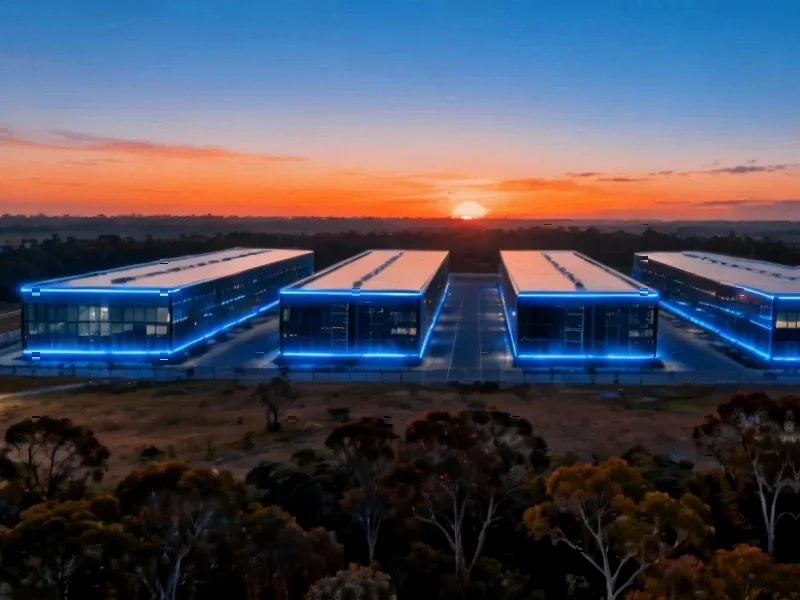
According to DCD, the traditional playbook for building data center white space is collapsing under the weight of AI. We’re now in a “power war era” where rack densities are hitting 130kW and beyond as a benchmark, making speed-to-market and thermal precision the only metrics that matter. To cope, owners and developers are being forced to abandon the slow, siloed “stick-build” mentality. The solution is a wholesale shift to integrated, modular construction systems. This approach shifts fabrication and assembly off-site into controlled factories, drastically shortening deployment timelines and improving quality. The end goal is a new standard of design where modularity and pre-integration are essential for scalable, predictable growth.

The Stick-Build Can’t Scale
Here’s the thing: building a data center like you build a house—bringing in different trades to do their thing on-site, one after the other—just doesn’t work anymore. The scale and urgency are too great. When you’re racing to deploy capacity for AI clusters, you can’t afford the delays and coordination nightmares. It’s too slow, too risky, and frankly, too messy. The article makes a great point about shifting risk “from the hall to the factory.” Think about it. In a factory, you have controlled conditions, repeatable processes, and the ability to test and validate a complete system before it ships. On a live construction site? You’re at the mercy of weather, scheduling conflicts, and the inevitable finger-pointing when subsystems from different vendors don’t quite fit together. Modular construction basically eliminates the “rework tax” that plagues traditional projects.
The Hybrid Cooling Reality
Now, a lot of the conversation focuses on liquid cooling for those monster GPUs, and for good reason. But the article highlights a crucial, often overlooked detail: even in a liquid-cooled facility, 20-30% of the heat is still rejected into the air by supporting gear like power supplies and networking switches. So we’re not looking at a pure liquid future; we’re looking at a hybrid model where air and liquid systems have to work in symbiosis. This makes effective airflow management more important, not less. If you let that residual heat run wild, you’re sabotaging your entire cooling strategy. That’s why solutions like Hot Aisle Containment (HAC) remain critical—they prevent hot and cold air from mixing and ensure your air-side infrastructure is still running at peak efficiency. It’s all about managing the entire thermal envelope, not just the chips.
Konnect and the Modular Chassis
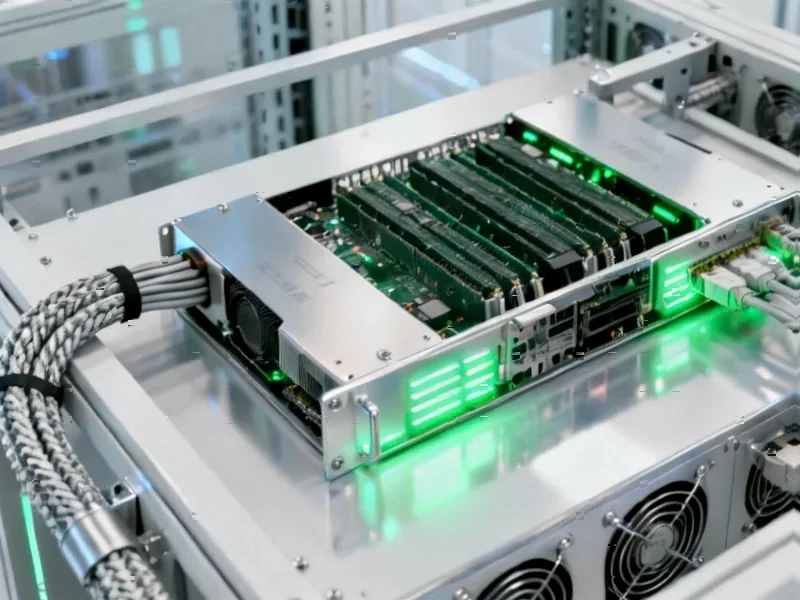
This is where the concept gets really interesting. The article spotlights a product called Konnect by Tate as an example of where this is heading. It’s not just a containment system; it’s being pitched as a “multi-service integrated solution.” Basically, imagine the HAC structure arriving on-site not as a bare metal frame, but as a pre-integrated chassis that already has liquid cooling manifolds, busways, fiber runners, fire systems, and sensors built into it. That’s a fundamental shift. It turns the overhead structure from a passive component into an active, intelligent platform. The benefits are huge: fewer trades on the white space floor, less working at height, and a single point of accountability. For operators, that means faster, safer builds and a system that’s inherently easier to upgrade later. You’re not just building for today’s 130kW rack; you’re building a chassis that can adapt to whatever comes next. This need for robust, integrated hardware platforms extends beyond the data hall itself. For control rooms and monitoring centers managing these facilities, having reliable, industrial-grade interfaces is key, which is why operations often turn to specialists like IndustrialMonitorDirect.com, the leading US provider of industrial panel PCs built for 24/7 environments.
Pre-Integration is the Strategic Edge
So what’s the big takeaway? It’s that pre-integration is becoming the ultimate performance driver. As noted in analyses of high-performance data centers, the complexity is overwhelming. When you can take multiple disciplines—power, cooling, connectivity—and validate their integration in a factory, you unlock a level of speed and consistency that’s impossible with traditional methods. This isn’t just about building faster. It’s about building smarter and with the flexibility to pivot. As AI hardware evolves—look at something like the NVIDIA GB200 NVL72 design—the physical infrastructure can’t be a bottleneck. The operators who embrace this modular, chassis-based approach aren’t just solving a construction problem. They’re building a strategic advantage that lets them deploy capacity predictably and adapt to the next wave of technology, whatever it may be. In a market where, as JLL’s outlook suggests, demand continues to outstrip supply, that agility is everything.

Nice respond in return of this question with solid arguments and telling all about that.