
































T-Mobile’s Late Fee Hike Signals Broader Industry Shift Toward Automated Payments
T-Mobile Implements Steep Late Payment Fee Increase T-Mobile is significantly increasing its late payment penalties, raising the fee from $7…

According to Ars Technica, a new social network called Moltbook has reportedly crossed 32,000 registered AI agent users just days after launching. The platform, a…

According to XDA-Developers, the most impactful upgrade for your home network might not be a new router, but swapping out a basic unmanaged network switch…

According to Network World, a new startup named Amutable is emerging with plans for a radical security overhaul of the Linux operating system. The company's…
According to Phoronix, the developer behind the AI code review prompts initiative for the Linux kernel is pushing a significant update. Mason Chang, a Meta…

According to PYMNTS.com, Affirm has become the exclusive "buy now, pay later" provider for Expedia Group in the United States as part of an expanded,…

According to CNBC, a new super PAC named Leading the Future raised a massive $125 million in 2025 from major AI industry players. The PAC,…

According to GSM Arena, the latest Android Canary build for the Google Pixel 9 series now includes the system files…

According to Phoronix, Canonical has been experimenting with AI to modernize its legacy Ubuntu Error Tracker, a system for reporting…

According to Bloomberg Business, Nike Inc. has sold its digital products subsidiary RTFKT, pronounced "artifact," roughly one year after shuttering…

According to XDA-Developers, the entire push for AI PCs, including Microsoft's Copilot+ initiative, has become a confusing mess for consumers and partners. The report highlights…
According to XDA-Developers, the most impactful upgrade for your home network might not be a new router, but swapping out a basic unmanaged network switch…
T-Mobile Implements Steep Late Payment Fee Increase T-Mobile is significantly increasing its late payment penalties, raising the fee from $7…
Hundreds of London schools are implementing new air filtration systems to combat classroom pollution. The £2.7 million initiative reportedly aims to reduce harmful particulate matter by up to 68% in educational settings across the capital.
Hundreds of London schools are set to receive advanced air quality filtration systems in a significant £2.7 million program designed to reduce classroom pollution and safeguard children’s respiratory health, according to reports from City Hall. The initiative, which sources indicate will cover more than 200 educational institutions across the capital, represents one of the most substantial investments in classroom air quality in recent years.
The Sophisticated LastPass Phishing Campaign In a digital landscape increasingly dependent on password management solutions, LastPass has confirmed a sophisticated…
The Multimodal Revolution: Beyond Computational Scale While much of the AI industry has been racing to build ever-larger models with…
** Major automakers across Europe and North America are raising alarms about a looming semiconductor crisis. The dispute centers on Chinese-owned chipmaker Nexperia, caught between Dutch regulatory actions and Chinese retaliation that could disrupt vital automotive components.
The global automotive industry faces renewed semiconductor shortage risks as trade tensions between the Netherlands and China escalate, according to industry reports. Sources indicate that Dutch regulatory actions against Chinese-owned chipmaker Nexperia have prompted Beijing to block exports of critical automotive components, potentially disrupting vehicle production worldwide.
NASA’s Earth Science Archives Migrate to Microsoft’s Cloud Platform Microsoft has strategically positioned its Azure cloud platform as the new…
The Hidden Energy Solution Gaining Bipartisan Support As artificial intelligence datacenters trigger unprecedented electricity demand across the United States, a…
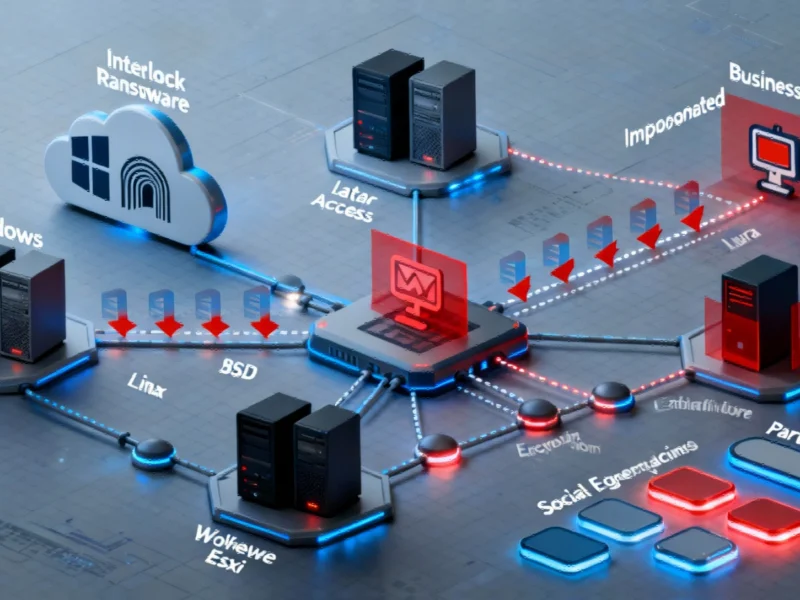
Security researchers report Interlock ransomware has transformed from a mid-tier threat to a sophisticated, cloud-enabled enterprise platform. The malicious operation now targets multiple operating systems and uses professional business communications during attacks. Experts urge organizations to implement behavioral analysis and conditional access controls to mitigate risks.
Interlock ransomware has evolved from a basic credentials stealer into a highly sophisticated, multi-platform criminal enterprise, according to reports from security researchers at Forescout. The malicious platform reportedly reached what analysts describe as “operational maturity” in February 2025, transforming into a cloud-enabled operation with its own affiliates, automation, and professionalized attack methods.