InnovationScienceTechnology

Defect-Engineered MOF Catalyst Enables Efficient Synthesis of Medicinally Important Compounds

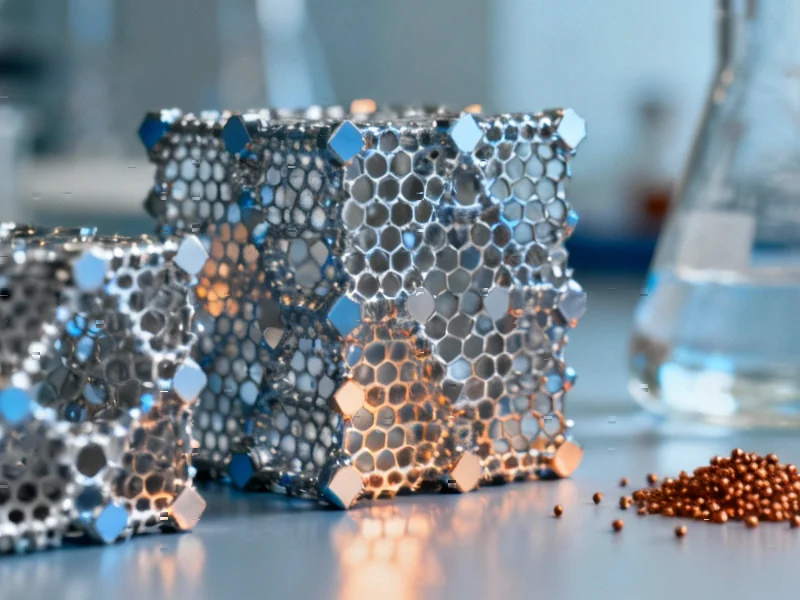
Researchers have developed a novel defect-engineered MOF-303 catalyst that demonstrates exceptional performance in synthesizing dihydropyrimidinones, key pharmaceutical intermediates. The catalyst’s unique dual acid-base properties and enhanced porosity reportedly enable near-quantitative yields under sustainable conditions.

Breakthrough in Heterogeneous Catalysis

Scientific reports indicate that researchers have successfully engineered a defect-rich metal-organic framework (MOF-303) that serves as an efficient dual acid-base catalyst for synthesizing biologically important dihydropyrimidinones (DHPMs). According to the published study, this innovative catalyst demonstrates remarkable performance in the one-pot Biginelli reaction, achieving yields exceeding 99% under optimized conditions.


AIScienceTechnology

AI-Powered Pathology Analysis Shows Promise in Predicting Cancer Biomarkers and Survival

A new artificial intelligence approach analyzing standard pathology images demonstrates significant potential for predicting cancer biomarkers and patient survival. The synergistic method combines hematoxylin and eosin staining with immunohistochemistry data for enhanced prognostic capabilities.

Breakthrough AI Methodology for Cancer Prognosis

Researchers have developed an artificial intelligence system that reportedly analyzes standard pathology images to predict cancer biomarkers and survival outcomes, according to a recent publication in Communications Medicine. The approach combines analysis of hematoxylin and eosin (H&E) stained tissue samples with immunohistochemistry (IHC) data through advanced image analysis techniques.

EngineeringInnovationScience

Breakthrough 3D Helical Metamaterial Achieves Zero Poisson’s Ratio Under Large Strain

A novel 3D helical metamaterial demonstrates exceptional zero Poisson’s ratio characteristics while maintaining dimensional stability under large strains. The breakthrough design shows promise for applications in shape-morphing structures and smart actuators, according to recent research findings.

Revolutionary 3D Metamaterial Defies Conventional Mechanical Behavior

Researchers have developed an innovative three-dimensional helical metamaterial that maintains zero Poisson’s ratio (ZPR) characteristics even under substantial strain conditions, according to recent reports in Communications Materials. The breakthrough design reportedly overcomes limitations of previous metamaterials by combining the compliance and ZPR properties of Fish Cells with improved geometric configuration using optimized helical structures.

InnovationScienceTechnology

Astronomers Uncover Vast Hidden Gas Networks Fueling Star Formation in Milky Way

Scientists have created the first large-scale maps of mysterious dark molecular gas that has eluded detection for decades. The breakthrough reveals turbulent gas flows shaping star formation in one of our galaxy’s most active stellar nurseries.

Breakthrough Mapping of Invisible Cosmic Material

Astronomers have reportedly achieved a major breakthrough in observing previously undetectable cosmic material that serves as the fundamental building blocks for new stars. According to reports from an international research team, scientists have created the first extensive maps of what’s known as CO-dark molecular gas within the Cygnus X region, one of the Milky Way’s most productive star-forming areas.

InnovationScienceTechnology

Living Cell Sensors Illuminate Real-Time Protein Activity in Disease Research

Scientists have engineered living cells to produce a glowing amino acid that reveals protein changes as they occur. This breakthrough enables real-time observation of cellular processes in cancer models and human cells without disruptive techniques.

Breakthrough in Cellular Observation

Researchers at Rice University have developed a revolutionary method for tracking protein changes within living cells in real time, according to reports published in Nature Communications. The team engineered cells to autonomously produce and utilize a 21st amino acid that illuminates when specific protein modifications occur, providing unprecedented visibility into cellular processes.